Key facts: Garage Door Opener Repair
- Federal rules require automatic residential garage door openers to include entrapment protection, typically a reversing mechanism with photo-eye sensors [1].
- Garage door openers move a door that is balanced by its springs; they are not designed to lift the full weight [2].
- Common opener drive types include chain, belt and screw drives, plus jackshaft units mounted beside the door [3].
- Thunderstorms and power outages are common in the Piedmont, when the emergency release is the way to open the door by hand [4].
In this page
- 1How a garage door opener works
- 2Common garage door opener symptoms
- 3Sensor figure
- 4Why garage door openers stop working
- 5How a technician diagnoses and repairs an opener
- 6Garage door opener types compared
- 7Opener checks homeowners can make
- 8Where homeowners should stop with openers
- 9Opener problems in Winston-Salem garages
- 10Repairing or replacing a garage door opener
- 11Door problems that look like opener problems
- 12Using the emergency release safely
- 13Smart openers, phones and Wi-Fi
- 14Openers with battery backup
- 15Outdoor keypads and remotes
- 16Opener light problems
- 17When the opener itself is noisy
- 18What limit and force settings do
- 19Getting safety sensors aligned again
- 20Worn gears inside the motor unit
- 21What to consider when replacing an opener
- 22Openers in older detached garages
- 23What a proper opener installation includes
- 24Living with an opener during storm season
- 25Keeping children safe around openers
- 26Why the opener depends on a balanced door
- 27Rail and chain care
- 28When only the wall button fails
- 29Sunlight and sensor problems
- 30How a technician tests a repaired opener
- 31Opener care in rental homes
- 32Humidity and opener electronics
- 33Opener problems that need a technician soon
- 34Questions about garage door opener repair
How openers work
How a garage door opener works
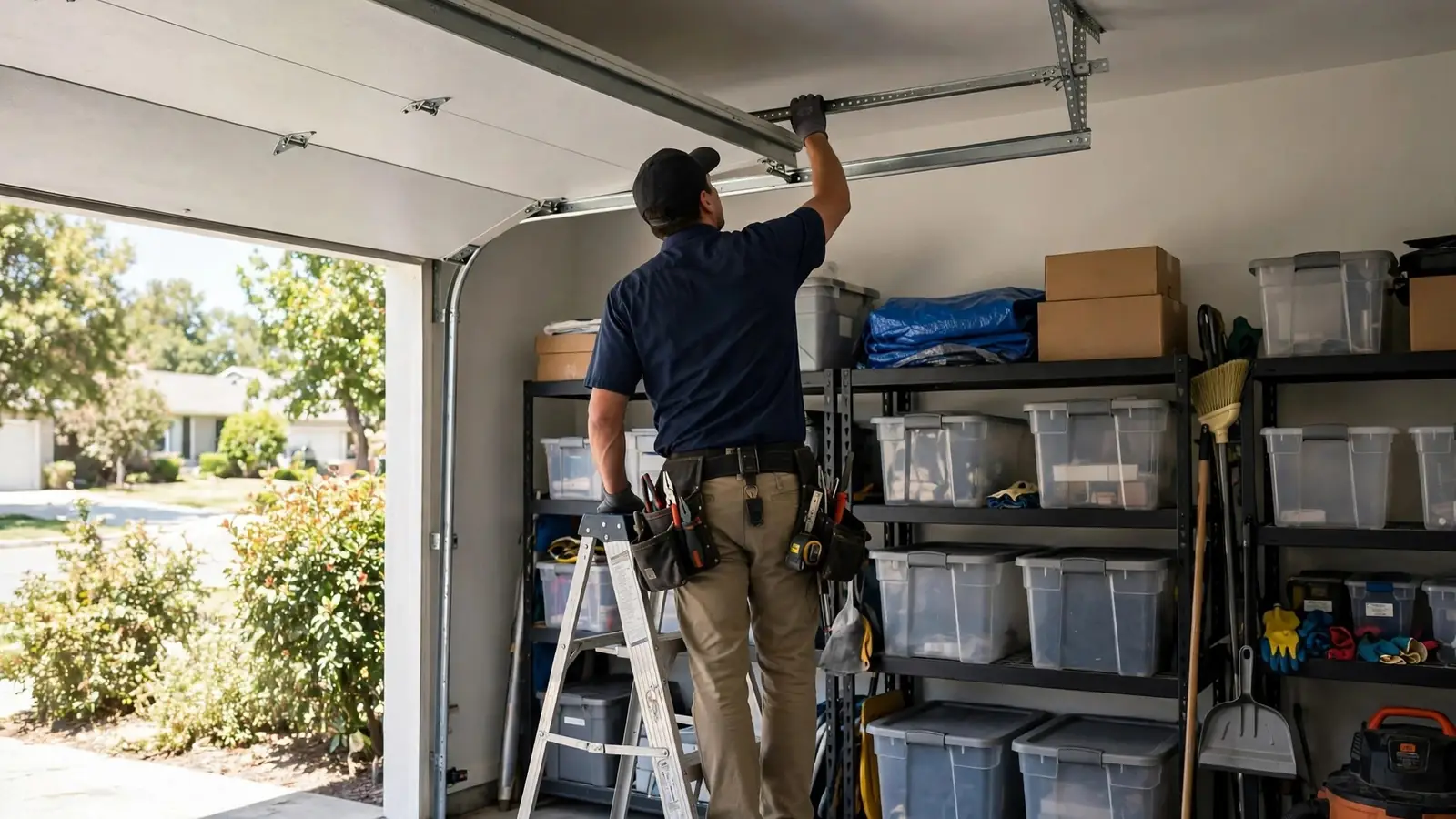
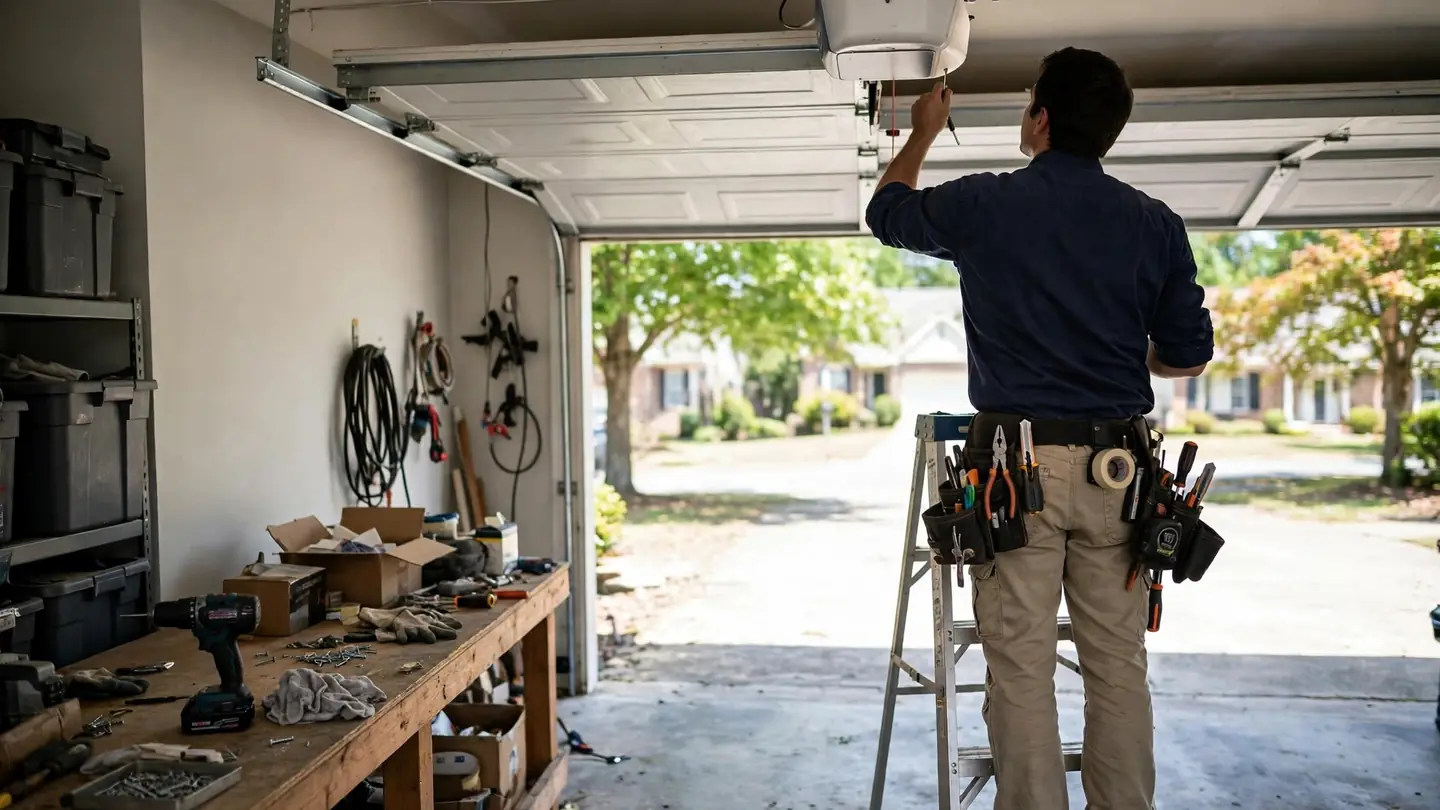
A typical ceiling-mounted opener has a motor unit hanging from the garage ceiling, a rail running toward the door and a trolley that slides along the rail. A chain, belt or screw drives the trolley, and an arm connects the trolley to the top of the door. When you press the button, the motor turns, the trolley moves and the door follows.
Jackshaft or wall-mount openers sit beside the door and turn the torsion shaft directly, freeing the ceiling. They suit garages with high ceilings or storage overhead.
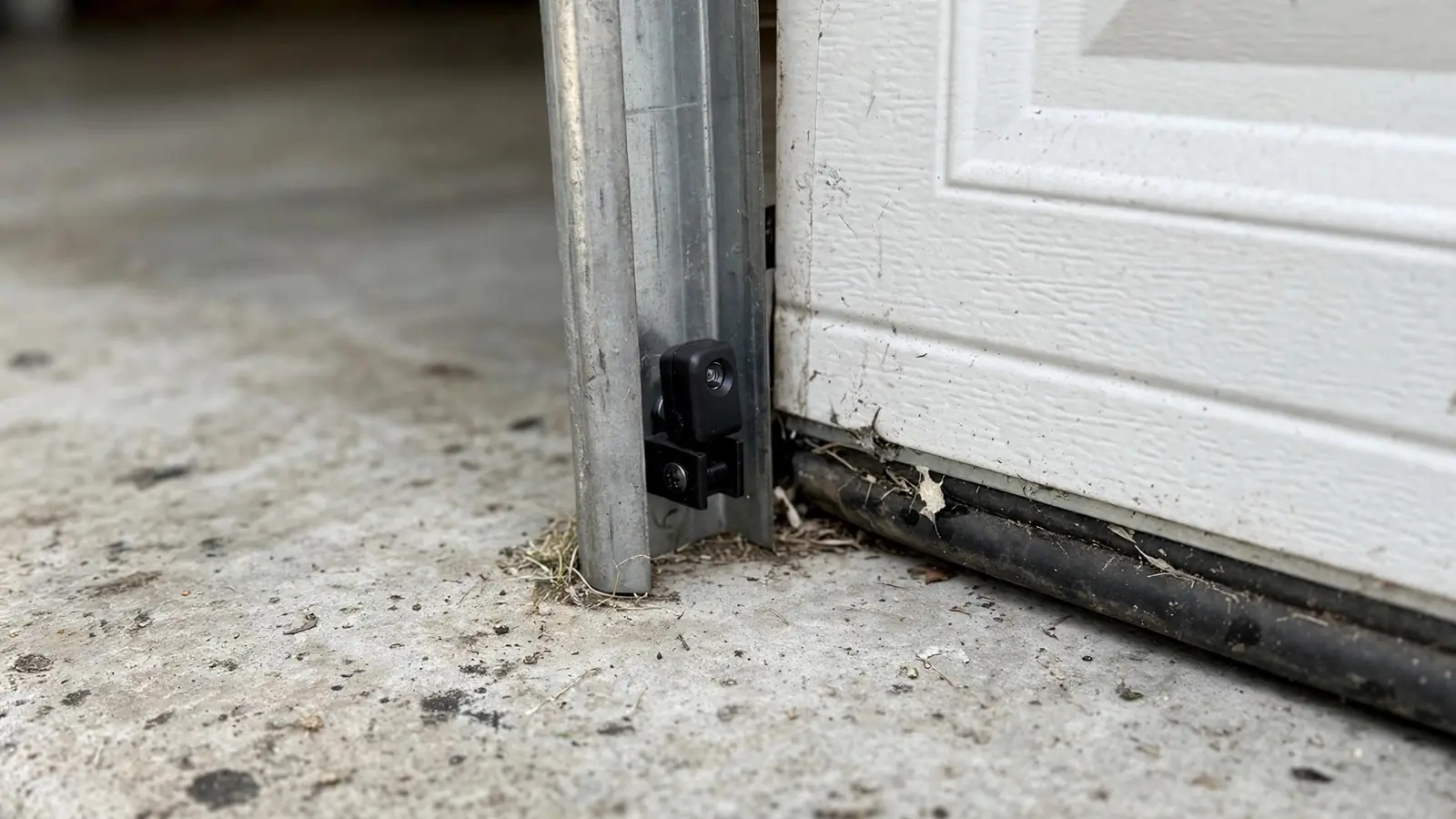
Every modern opener has limit settings that tell it where to stop at the top and bottom, and force settings that tell it how hard to push before deciding something is wrong. Near the floor, photo-eye sensors on each side of the door send an invisible beam across the opening. If something breaks the beam while the door is closing, the opener reverses. The opener should also reverse if the door touches an obstruction.
Remotes, keypads and wall buttons send the signal. Many newer openers also connect to phones and home networks. Any of these can fail independently of the motor.
Opener warning signs
Common garage door opener symptoms
Opener problems usually show up in one of these ways.
Hums but nothing moves
Stripped gear, disengaged trolley or a broken spring.
Read moreDoor reverses before closing
Blocked or misaligned sensors, or force set too low.
Remote does nothing, wall button works
Remote battery or programming.
Nothing works at all
Power, breaker, GFCI outlet or a failed logic board.
Read moreDoor stops partway up
Limits, force or a door binding in its track.
Read moreGrinding or clicking from the motor
Worn gear or sprocket.
Sensor figure
Why openers fail
Why garage door openers stop working
The most common opener failures are not the motor. Safety sensors get bumped by bikes and trash cans and fall out of alignment. Their lenses gather dust, pollen and spider webs, which is a frequent problem in Winston-Salem's spring pollen season. Sunlight shining directly into a sensor at certain times of day can confuse it.
Inside the motor unit, many openers use a plastic drive gear that wears and strips over time, especially if the opener has been straining against an unbalanced door. Trolleys can disengage after someone pulls the emergency release. Logic boards can fail after power surges, which come with summer thunderstorms.
Remotes run on small batteries that fade. Keypads outside are exposed to weather. Wall buttons and their wiring get damaged.
Finally, many opener problems are really door problems: a broken spring, a binding roller, a bent track or a frozen bottom seal. The opener senses the extra resistance and stops or reverses.
Opener repair step by step
How a technician diagnoses and repairs an opener
- 1
Check the door first
Disconnect the opener and test the door by hand for balance and smooth travel.
- 2
Check power
Confirm the outlet, breaker and any GFCI are working.
- 3
Test sensors
Check alignment, lenses and wiring; watch the indicator lights.
- 4
Inspect the drive
Look at the gear, sprocket, chain or belt tension and the trolley.
- 5
Adjust limits and force
Set the open and close positions and force to the door.
- 6
Test reversal
Confirm the door reverses on contact and when the beam is broken.
- 7
Check controls
Test remotes, keypad and wall button, and reprogram as needed.
Opener types
Garage door opener types compared
| Drive type | How it moves the door | Notes |
|---|---|---|
| Chain drive | Metal chain pulls the trolley | Durable; louder in garages under bedrooms |
| Belt drive | Rubber belt pulls the trolley | Quieter; popular with attached garages |
| Screw drive | Threaded rod moves the trolley | Fewer parts; sensitive to temperature in some models |
| Jackshaft (wall-mount) | Turns the torsion shaft directly | Frees the ceiling; needs a torsion system |
| Older openers without photo-eyes | Varies | Lack required safety features; replace |
What you can do yourself
Opener checks homeowners can make
These checks are safe and often solve the problem.
- Check that the opener is plugged in and the outlet works.
- Reset any tripped breaker or GFCI outlet.
- Replace remote batteries.
- Wipe the sensor lenses with a soft cloth.
- Make sure nothing blocks the beam between the sensors.
- Check that both sensor lights are steady; a blinking light often means misalignment.
- If the trolley is disengaged, follow the manual to re-engage it with the door closed.
- Test the reversal monthly with a soft object such as a roll of paper towels under the door.
Opener work limits
Where homeowners should stop with openers
Replacing gears, logic boards and drive components involves opening the motor unit and working on a ladder near moving parts. More importantly, many opener symptoms come from the door itself, and adjusting force settings upward to overcome a binding door hides a dangerous problem. If the door is heavy by hand or moves unevenly, leave the opener alone and call.
Opener repair in Winston-Salem: local specifics
Opener problems in Winston-Salem garages
Winston-Salem's weather gives openers a workout. Summer thunderstorms bring power outages and surges that can damage logic boards. Spring pollen coats sensor lenses yellow. Winter ice can freeze a door to the slab, and an opener trying to lift it will strain its gear or trip its force limit.
Housing matters too. Detached garages behind older bungalows in Ardmore and the West End may have no outlet near the ceiling or older wiring, so installing or replacing an opener there can involve electrical work. Attached garages in newer subdivisions in Clemmons and Kernersville usually have bedrooms above, where a quiet belt drive is popular.
In historic overlay districts, an opener itself is not visible, but replacing the door it lifts may require review.
Opener repair or replace
Repairing or replacing a garage door opener
| Situation | Repair | Replace |
|---|---|---|
| Sensors misaligned or dirty | Yes | No |
| Stripped gear on a recent opener | Yes | No |
| Logic board failure on an old opener | Possible | Often sensible |
| Opener has no safety sensors | No | Yes |
| Door is heavy because of springs | Fix springs first | Not the opener's fault |
| Want quieter operation or smart features | Not needed | Optional upgrade |
Related problems
Door problems that look like opener problems
Broken springs, frayed cables, worn rollers, bent tracks and frozen seals all make an opener stop or reverse. Technicians always test the door by hand first. If the door is fine, the opener is the problem; if not, the door gets fixed first.
Emergency release
Using the emergency release safely
The red-handled cord hanging from the trolley disconnects the opener so the door can be moved by hand. Use it during power outages or when the opener fails, but only with the door closed if possible. If a spring is broken and the door is open, pulling the release can let the door fall. Re-engage the trolley according to the manual when power returns.
Smart openers and connectivity
Smart openers, phones and Wi-Fi
Many newer openers connect to phone apps and home Wi-Fi. Connection problems are often fixed by updating the app, resetting the router connection or moving the opener's Wi-Fi module. The safety requirements still apply, and unattended remote closing usually involves warning lights and sounds.
Battery backup openers
Openers with battery backup
Some openers include a battery backup that runs the door during power outages, useful during storm season. Batteries wear out over a few years and need replacement. If the opener beeps or the backup fails, the battery is the likely cause.
Keypads and remotes
Outdoor keypads and remotes
Outdoor keypads face weather and can fail from moisture. Remotes lose programming after battery changes on some models. Reprogramming usually involves pressing a learn button on the motor unit. A technician can do this, or the manual explains it.
Lights and the opener
Opener light problems
Opener lights that fail to turn on may need new bulbs suited to the vibration of the motor unit, or the light socket or logic board may be at fault. Some LED bulbs interfere with remote signals; opener-compatible bulbs avoid this.
Noisy openers
When the opener itself is noisy
A loud opener may have a loose chain, worn sprocket or dry rail. Chain drives are louder by nature. Belt drives are quieter. Tightening and lubricating as the manual directs can help. Persistent grinding suggests gear wear.
Limit and force settings explained
What limit and force settings do
Limit settings tell the opener where the door's fully open and fully closed positions are. If the close limit is set too short, the door stops above the floor; too long, and the opener pushes into the floor and reverses. Force settings define how much resistance the opener will tolerate before reversing. Newer openers often learn these settings automatically during setup, while older ones use adjustment screws. After any door repair, such as new springs, limits and force should be checked because the door's behavior changes.
Talk to a local contractor
Questions about garage door opener repair?
One call connects you with an independent garage door repair contractor who serves Winston-Salem.
Sensor alignment in practice
Getting safety sensors aligned again
Photo-eye sensors sit a few inches above the floor on each side of the door. One sends an invisible beam; the other receives it. Indicator lights show whether the beam is received. If one light blinks or is off, the sensors are out of line. Loosening the bracket, aiming the sensor until the light is steady and tightening it again usually fixes it. Wires stapled along the wall can be damaged by rodents or tools, which also causes faults.
Gear and sprocket wear
Worn gears inside the motor unit
Many chain and belt openers use a plastic drive gear inside the motor housing. Over years of use, and faster if the door has been heavy, the gear teeth wear down. A worn gear makes the motor run while the door stays put, or produces grinding. Replacing the gear and sprocket assembly restores the opener if the rest of it is sound. Technicians check the door's balance first, because a heavy door will strip a new gear too.
Choosing a new opener
What to consider when replacing an opener
If an opener is old, lacks safety sensors or keeps failing, replacement may make sense. Consider noise (belt drives are quieter), the door's size and weight, ceiling height and whether you want a wall-mount unit, battery backup or phone control. The technician can recommend a unit suited to your door and garage and install it with properly set limits, force and sensors.
Openers and older detached garages
Openers in older detached garages
Many older Winston-Salem homes have small detached garages with lightweight doors, sometimes converted from swing doors. These garages may lack a ceiling outlet or have limited headroom. Installing an opener can require an electrician to add an outlet and a technician to confirm the door is suitable and balanced. Wall-mount openers can help where headroom is tight, if the door uses a torsion system.
Opener installation details
What a proper opener installation includes
A proper installation secures the motor unit to solid framing, not just drywall, mounts the header bracket firmly above the door, installs the sensors at the right height on both sides, runs low-voltage wires neatly and out of the way, mounts the wall button out of children's reach, and sets limits and force to the door. The installer then tests the reversal both by contact and by breaking the beam. Many problems with openers trace back to shortcuts in one of these steps.
Openers and power outages
Living with an opener during storm season
Piedmont thunderstorms and the occasional ice storm knock out power. Without a battery backup, the door must be opened by hand using the emergency release. Practicing the release once in good weather, with the door closed, means you will know how it works when the lights go out. Remember to re-engage the trolley afterward, or the opener will run without moving the door.
Children and opener safety
Keeping children safe around openers
Mount wall buttons high, keep remotes away from children and teach them not to play under or near a moving door. Test the reversal monthly. Federal safety rules exist because of entrapment injuries, and keeping the sensors and reversal working is the most important opener maintenance task.
Garage door and opener balance
Why the opener depends on a balanced door
An opener is sized to move a balanced door. If springs weaken, the opener works harder, its gear wears faster, and it may reverse or stall. When a technician repairs an opener, checking the door's balance first protects the new parts. If the springs need attention, fixing them extends the opener's life.
Lubricating the opener rail
Rail and chain care
Chain-drive openers benefit from occasional light lubrication of the chain and rail according to the manual. Belt drives generally need no lubrication on the belt. Screw drives often require a specific grease on the threaded rod. Using the wrong lubricant attracts dust and pollen.
Openers and sunlight
Sunlight and sensor problems
At certain times of year, low sunlight can shine straight into a sensor and confuse it, making the door reverse in the late afternoon. Swapping the sending and receiving sensors, shading the receiver or adjusting its angle usually solves it. If a door only reverses at a particular time of day, sunlight is a likely cause.
Testing after a repair
How a technician tests a repaired opener
After repair, the technician runs the door several full cycles, checks that it stops at the right positions, places an object under the door to confirm contact reversal, breaks the sensor beam during closing, and tests remotes and the wall button. They should show you how to repeat the monthly safety test.
Garage door openers in rentals
Opener care in rental homes
Landlords should make sure openers in rental homes have working sensors and reversal, test them at turnover and give tenants the manual or simple instructions for the emergency release. Disabled or bypassed sensors are a safety hazard and should be repaired.
Openers in humid garages
Humidity and opener electronics
In humid, uninsulated garages, condensation can form on opener circuit boards and outdoor keypads, especially when cool nights follow hot days. Corrosion on contacts causes intermittent faults. Keeping the garage ventilated and the opener cover in place helps. Keypads mounted outside benefit from a little shelter from rain.
When to call about an opener
Opener problems that need a technician soon
Call promptly if the door does not reverse when it touches an object, if the opener runs but the door moves unevenly, if you hear grinding from the motor or see sparks, or if the door is heavy by hand. These can signal safety problems or a door issue that will damage the opener further.
Opener questions
Questions about garage door opener repair
Why does my garage door go back up when I try to close it?
Usually the safety sensors are blocked, dirty or misaligned. Check for objects and clean the lenses. If that fails, the force or limits may need adjusting.
My opener hums but the door doesn't move. What's wrong?
The trolley may be disengaged, the drive gear stripped or a spring broken. Check the door by hand first.
Why did my remote stop working?
The battery may be dead, or the remote may need reprogramming. If the wall button works, the opener is probably fine.
Can I increase the force setting so the door closes?
Not as a fix. Raising the force to overcome a binding door hides a problem and can make the door unsafe.
Do I need sensors on my opener?
Federal rules require entrapment protection on automatic residential openers, usually photo-eye sensors plus contact reversal. [1]
Should I replace an old opener?
If it lacks safety sensors, yes. Otherwise, repair is often worthwhile unless parts are unavailable.
What causes openers to fail after storms?
Power surges can damage logic boards. A surge protector can help.
Why does my door reverse only in the late afternoon?
Low sunlight can shine into a sensor and confuse it. Swapping the sensors or shading the receiver often helps.
Why does my door stop a few inches above the floor?
The close limit may be set short, or the door may be binding. A technician can adjust limits after confirming the door moves freely.
Can I install a new opener on an old door?
Usually, if the door is balanced and in good condition. A technician checks the door and springs before installing a new opener.
Why does my keypad work only sometimes?
Weak batteries, moisture or a damaged keypad are common causes. Replacing the battery or keypad usually fixes it.
Should my opener have a battery backup?
It is useful in storm-prone areas, letting the door run during outages. Batteries need replacing every few years.
Can a power surge damage my opener?
Yes, surges from storms can damage logic boards. A surge protector at the outlet helps.
How often should I test the safety reversal?
Monthly, using a soft object under the door and by breaking the sensor beam while it closes.