Key facts: Broken Spring Replacement
- Torsion springs store energy by twisting and use that energy to counterbalance the weight of the door [1].
- Sectional garage doors are lifted mainly by their springs; the opener only guides a balanced door [2].
- Automatic openers must include entrapment protection under federal rules, so the opener should be retested after spring work [3].
- Industry groups such as DASMA publish technical guidance on garage door springs and safe service [4].
In this page
- 1What garage door springs actually do
- 2Signs your garage door spring has failed or is failing
- 3Broken spring figure
- 4Why garage door springs break
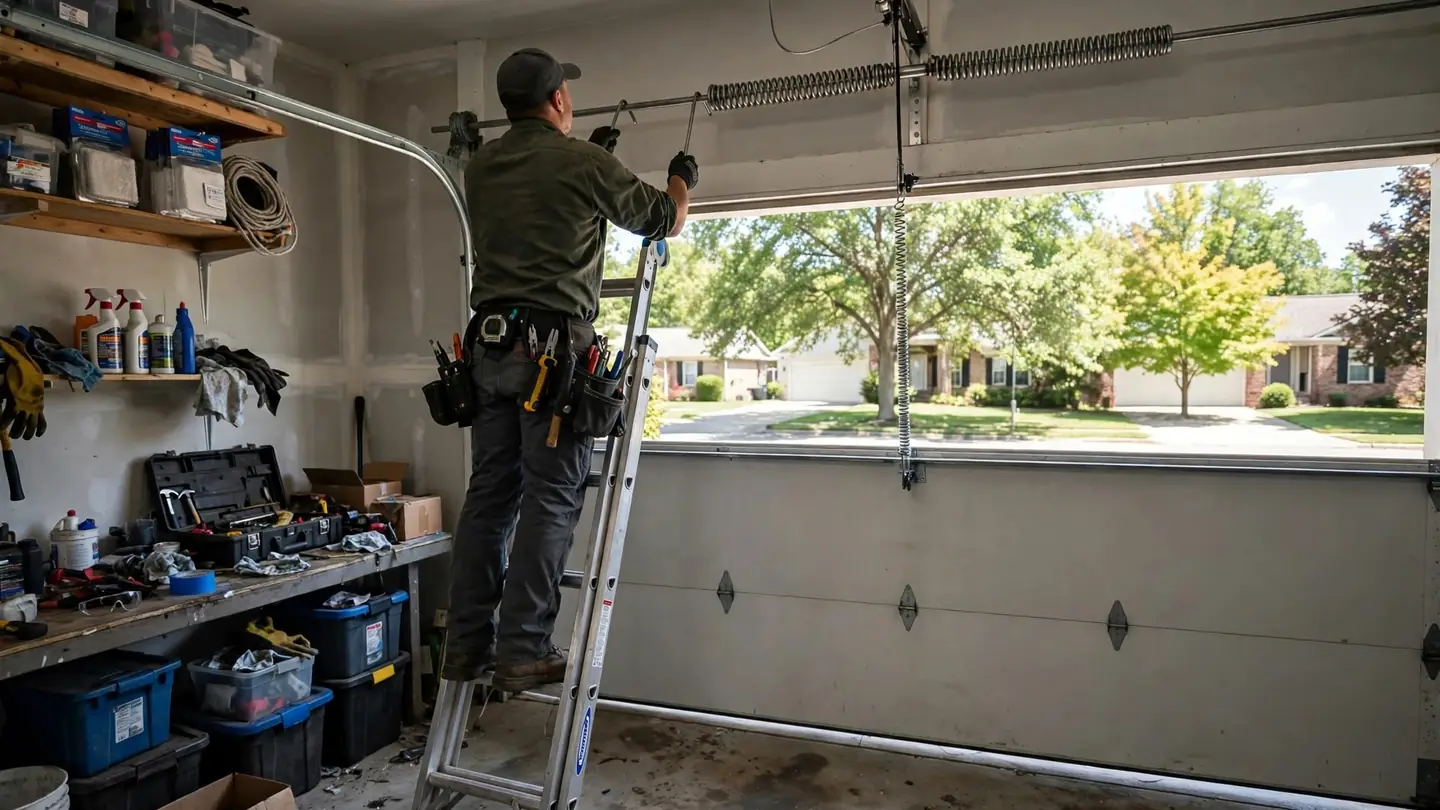
- 5How a technician replaces a broken torsion spring
- 6Garage door spring types compared
- 7Safe steps when a spring breaks
- 8Why spring work is not a DIY job
- 9Spring problems in Winston-Salem garages
- 10When a spring repair is enough
- 11Problems that come with a broken spring
- 12How usage affects spring life
- 13Why both springs are usually replaced
- 14Switching from extension springs to torsion springs
- 15Safety cables for extension spring doors
- 16Cold weather and spring failures in Forsyth County
- 17Caring for new springs
- 18Spring strain in busy garages
- 19How technicians size a replacement spring
- 20The parts that work with the spring
- 21Why heavier doors need stronger springs
- 22Warning signs before a spring snaps
- 23A typical spring replacement visit
- 24How extension springs are replaced
- 25Spring noise in garages below living space
- 26What to do if a spring breaks with the door open
- 27Coated springs and rust resistance
- 28Springs on older single-car garage doors
- 29When a spring fails during a power outage
- 30Questions about garage door spring replacement
How garage door springs work
What garage door springs actually do
A residential sectional garage door is heavy. Steel doors, insulated doors and wood doors all weigh far more than a person can comfortably lift. The springs make the door feel light by storing energy as the door closes and releasing it as the door opens, so the door is balanced at any height.
There are two main types. Torsion springs mount on a steel shaft above the door opening. As the door closes, cables wound on drums at each end of the shaft twist the springs tighter. When the door opens, the springs unwind and turn the drums, lifting the door. Extension springs run along the horizontal tracks on each side and stretch as the door closes, pulling it up as it opens through a system of cables and pulleys.
In both systems, the opener does not lift the door. It moves a balanced door. That is why a broken spring stops even a powerful opener, and why an opener straining against a door with a weak spring wears out quickly.
Springs are sized for the specific door: its weight, height and the drum size. A technician measures the old spring's wire size, inside diameter and length, or weighs the door, to select a correct replacement. On two-spring doors, both springs are usually replaced together so they wear evenly.
Spring warning signs
Signs your garage door spring has failed or is failing
Some signs are dramatic; others creep up over months.
A loud bang from the garage
A torsion spring snapping often sounds like a gunshot.
Read moreA visible gap in the spring
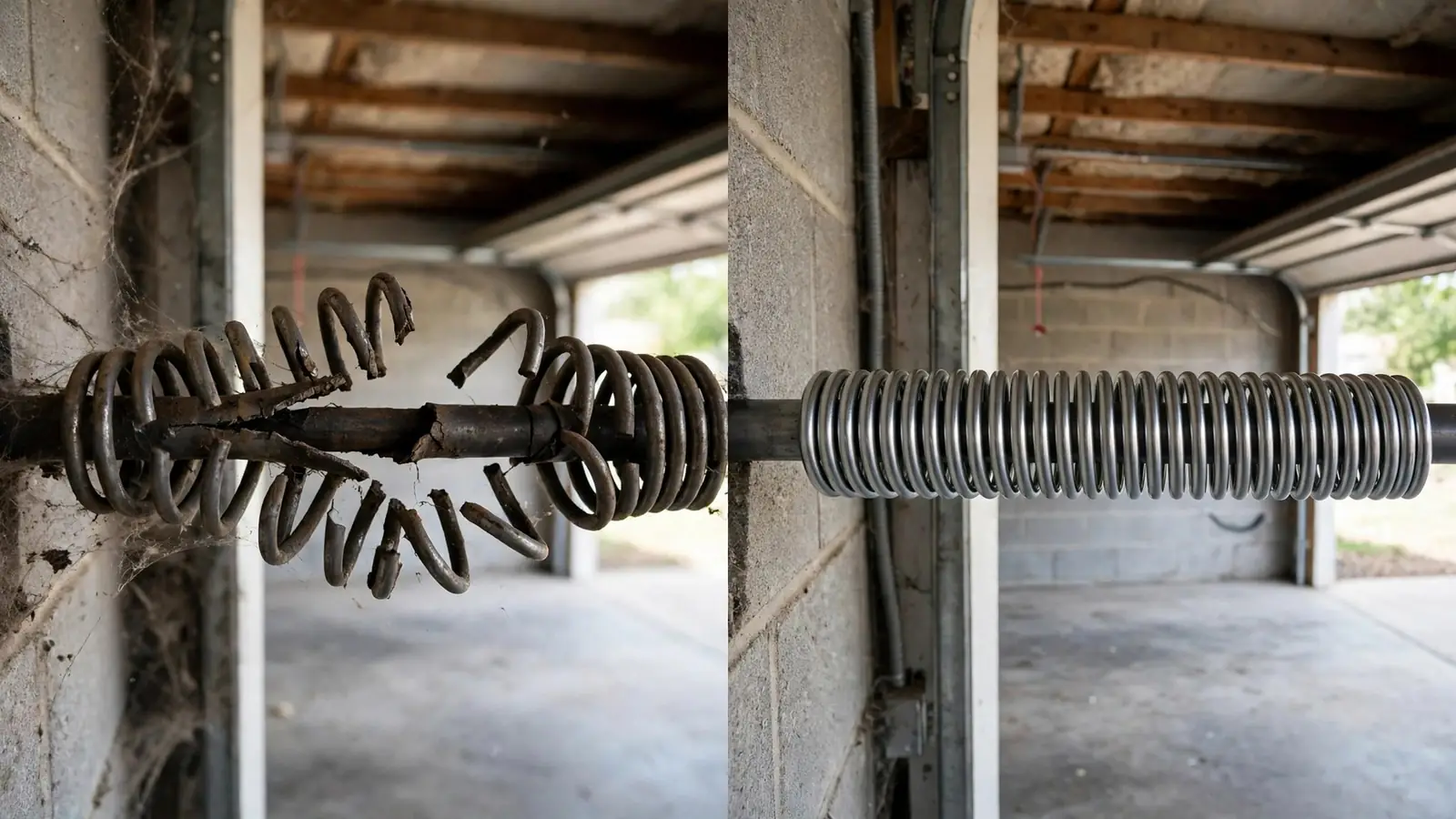
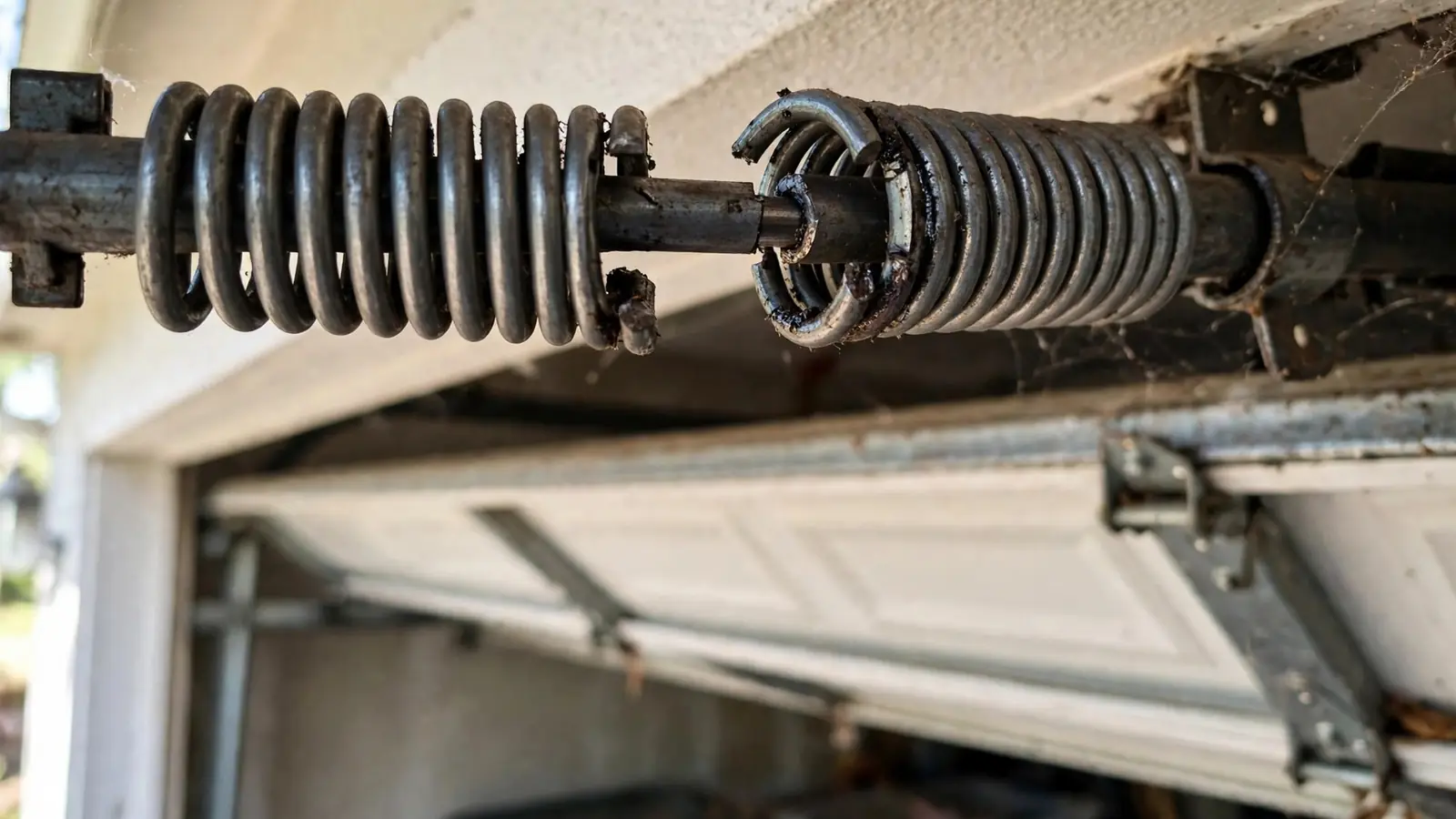
On torsion springs, a two-inch gap between coils shows the break.
Door feels very heavy by hand
Without spring help, the door is nearly impossible to lift.
Read moreOpener strains and stops
The opener reverses or stops a few inches up.
Read moreDoor slams shut or rises crooked
A weak or broken spring on one side lets the door drop or tilt.
Read moreLoose or slack cables
When a spring fails, cables can jump off the drums.
Read more
Broken spring figure
Why springs break
Why garage door springs break
Springs are designed for a limited number of open-and-close cycles. Each cycle twists or stretches the steel and slowly fatigues it. A family that uses the garage as its main entrance may run the door several times a day, which adds up quickly. Eventually the steel cracks and the spring snaps, usually when the door is closed and the spring is under the most tension.
Rust shortens the life of a spring. Winston-Salem's humid summers and occasional wet winters encourage corrosion on bare springs, especially in garages that are not climate controlled. Rust roughens the coils, increases friction and creates weak points.
Cold snaps add stress. Steel becomes less forgiving at low temperatures, and many springs fail on the first cold mornings of winter. A door that is out of balance, with a frozen bottom seal or binding rollers, also puts extra load on the springs every cycle.
Incorrect springs fail early too. If a previous repair used a spring that was too small for the door, or only one of two springs was replaced, the springs work harder than designed.
Spring replacement step by step
How a technician replaces a broken torsion spring
- 1
Secure the door
The door is closed and clamped to the track so it cannot move.
- 2
Release tension
Any remaining tension is let off with winding bars, one quarter turn at a time.
- 3
Remove the old spring
Set screws are loosened and the broken spring is slid off the shaft.
- 4
Fit matched springs
New springs sized to the door are installed, often both sides together.
- 5
Wind to the correct turns
The springs are wound to the right number of turns for the door height.
- 6
Check cables and drums
Cables are seated evenly and checked for fraying.
- 7
Balance and test
The door is tested by hand, then the opener force and reversal are rechecked.
Spring types
Garage door spring types compared
| Spring type | Where it mounts | Notes |
|---|---|---|
| Standard torsion | On a shaft above the door | Common on newer doors; smoother and more controlled |
| Extension | Along each horizontal track | Common on older and lighter doors; needs safety cables |
| Torsion on a single-car door | One spring on the shaft | Door stops working entirely when it breaks |
| Torsion on a double door | Often two springs | Both usually replaced together |
| Enclosed torsion systems | Spring inside the shaft tube | Proprietary parts on some brands |
| Oil-tempered vs galvanized | Spring finish | Galvanized resists rust in humid garages |
What you can do yourself
Safe steps when a spring breaks
These steps keep you safe until a technician arrives.
- Leave the door closed if it is closed.
- If the door is open, keep people and cars clear and do not try to close it with the opener.
- Unplug the opener so it does not keep straining.
- Do not pull the emergency release if the door is open; it may slam down.
- Note whether you have one spring or two and whether they sit above the door or along the tracks.
- Take a photo of the broken spring from a safe distance.
Spring work limits
Why spring work is not a DIY job
Torsion springs hold enough energy to lift a heavy door, and winding or unwinding them by hand with improper tools has caused serious injuries. Screwdrivers slip, bars fly and fingers get caught. Extension springs can snap and whip if they lack safety cables. Technicians use solid winding bars, clamps and a set procedure every time. For homeowners, the safe line is clear: look, photograph and call.
Spring replacement in Winston-Salem: local specifics
Spring problems in Winston-Salem garages
Winston-Salem's mix of housing means a mix of spring systems. Older detached garages behind Ardmore and West End bungalows often have lighter doors with extension springs, or doors converted from swing-out styles. Mid-century ranches in neighborhoods across the city typically have single doors with one torsion spring. Newer homes in Clemmons, Lewisville and Kernersville usually have double doors with one or two torsion springs and insulated steel panels, which are heavier.
Humidity is the local enemy of springs. Garages in Forsyth County see hot, sticky summers, and many are not insulated. Galvanized or coated springs resist rust better. Light lubrication of the coils during routine service also helps.
Winter matters too. The first cold mornings often bring a wave of spring failures, and ice storms can freeze a door to the slab. Running the opener against a frozen door stresses springs and cables.
Spring repair or door replacement
When a spring repair is enough
| Situation | Spring repair | Consider a new door |
|---|---|---|
| Spring broke on a sound door | Yes | No |
| Repeated spring failures | Check sizing and balance | If the door is damaged or very heavy for its system |
| Panels creased or rotted | Repair possible | Often better |
| Old door with extension springs | Yes, add safety cables | If upgrading insulation or style |
| Opener also failing | Repair both | Consider door and opener together |
Related problems
Problems that come with a broken spring
When a spring breaks, cables often loosen and can jump off their drums. Rollers may pop out of the track if someone tries to lift the door. The opener may have strained against the dead weight and damaged its gear or rail. A good technician checks all of these after replacing the spring.
Spring cycles and usage
How usage affects spring life
Every trip in or out of the garage is a cycle: one opening and one closing. Households that enter through the garage several times a day use up spring cycles far faster than those who open it once a day. If your garage is your front door, consider asking about higher-cycle springs when replacing them. They are larger or made from heavier wire and last longer for the same door.
Matching both springs
Why both springs are usually replaced
On doors with two torsion springs, both were installed at the same time and have seen the same number of cycles. When one breaks, the other is usually close behind. Replacing both together keeps the door balanced and avoids a second service call soon after. Technicians also match the springs to the door's weight rather than simply copying the old ones, in case the door was modified.
Converting extension to torsion
Switching from extension springs to torsion springs
Some older doors with extension springs can be converted to a torsion system. Torsion springs give smoother, more controlled travel and keep the springs in one place above the door. A conversion requires a shaft, drums, bearings and a spring anchor. A technician can say whether your door and headroom suit it.
Safety cables on extension springs
Safety cables for extension spring doors
Extension springs should always have safety cables running through their centers. If a spring breaks, the cable keeps the pieces from flying across the garage. Many older garages lack them. Adding safety cables is a simple, important upgrade.
Winter and springs
Cold weather and spring failures in Forsyth County
On the first cold mornings of the year, technicians often see a rush of broken springs. Cold steel is less forgiving, and springs near the end of their life finally give out. If your door is slow or heavy as temperatures drop, have the springs checked before winter.
Talk to a local contractor
Questions about broken spring replacement?
One call connects you with an independent garage door repair contractor who serves Winston-Salem.
After spring replacement
Caring for new springs
After replacement, lubricate the springs lightly during routine maintenance, keep the door balanced and test the opener's reversal monthly. Listen for new noises and watch for the door drifting when stopped halfway.
Garages used as workshops
Spring strain in busy garages
Some Winston-Salem homeowners use their garages as workshops or gyms, opening the door many times a day for ventilation. That use wears springs faster. Higher-cycle springs and regular checks make sense.
Measuring a spring
How technicians size a replacement spring
Torsion springs are defined by wire size, inside diameter, length and wind direction. A technician measures the old spring by counting coils over a set length to find the wire size, checks the inside diameter stamped on the cones or measured directly, and notes whether it is a left- or right-wound spring. When the old spring is missing or mismatched, they may weigh the door with the springs released and calculate a spring that balances that weight for the door's height and drum. Getting the size right matters: an undersized spring wears out early and lets the door drop; an oversized one makes the door fly up.
Drums, bearings and the shaft
The parts that work with the spring
The spring connects to a steel shaft that runs across the top of the door. At each end, a cable drum turns with the shaft, winding the lift cable as the door rises. Bearings at the ends and center support the shaft. When a spring breaks suddenly, the shaft can jolt and the cables can slip off the drums. Worn bearings make grinding noises and let the shaft wobble. During a spring replacement, the technician checks the drums for cracks, the set screws for tightness, the bearings for wear and the shaft for bends.
Door weight and insulation
Why heavier doors need stronger springs
Insulated steel doors, doors with windows and wood or wood-look composite doors weigh more than thin single-layer steel doors. If a door was replaced or modified with heavier panels without changing the springs, the old springs will be undersized and fail early. If you added insulation kits or windows, mention it when you call so the technician can size springs for the current weight.
Signs of a spring wearing out
Warning signs before a spring snaps
Springs often give warning before they break. The door may start drifting down when stopped halfway, rise more slowly, or the opener may start straining. Gaps may appear between coils that were once tightly packed, or rust may build up on the coils. If you notice these signs, a check before the spring breaks can avoid being stuck with the door closed and the car inside.
What a spring replacement visit looks like
A typical spring replacement visit
A technician arrives, confirms the door is closed and secure, and looks at the springs, cables, drums and opener. They explain what broke and what they recommend, including whether to replace one or both springs and whether any cables or rollers are worn. Once you agree, the replacement usually takes part of a visit. The technician balances the door, tests it by hand, reconnects and tests the opener, including the safety reversal, and shows you how the door should feel.
Extension spring replacement
How extension springs are replaced
Extension springs hang above the horizontal tracks, attached to the track hanger at one end and to a pulley and cable at the other. When the door closes, they stretch. Replacing them means opening the door fully so the springs are at rest, clamping the door, and swapping both springs together so they pull evenly. The safety cables threaded through each spring are checked or added. Pulleys and cables are inspected because worn pulleys and frayed cables often go with old springs.
Garages under bedrooms
Spring noise in garages below living space
In homes with bedrooms over the garage, a common layout in newer Clemmons and Kernersville subdivisions, spring and opener noise carries into the house. Squeaks from dry springs, clunks from worn bearings and the bang of a spring snapping are all more noticeable. Quiet operation depends on balanced springs, lubricated coils and bearings, nylon rollers and a belt-drive opener.
When the door is stuck open
What to do if a spring breaks with the door open
If a spring breaks while the door is open, the door is held up only by the opener and its trolley, or by friction. Do not pull the emergency release, and do not try to close it with the opener. Keep people and vehicles out from under it. Unplug the opener. A technician can secure the door and lower it safely before replacing the spring.
Spring paint and finishes
Coated springs and rust resistance
Springs come in plain oil-tempered steel, painted or powder-coated finishes and galvanized versions. In humid Winston-Salem garages, coated or galvanized springs resist rust better, which helps them reach their rated life. Whatever the finish, a light coat of garage door lubricant on the coils once or twice a year reduces friction and noise.
Springs on older one-car doors
Springs on older single-car garage doors
Many older Winston-Salem homes have single-car doors with one torsion spring. When that spring breaks, the door stops entirely, since there is no second spring to carry any of the load. If your single door is original or the spring has never been replaced, it is likely near the end of its life. Having it checked before it fails can avoid a morning when the car is trapped inside.
After a power outage
When a spring fails during a power outage
Sometimes homeowners discover a broken spring during a power outage, when they pull the emergency release and find the door will not lift. If the door is closed and does not budge with reasonable effort, the spring is likely broken. Do not force it. Wait for a technician rather than trying to prop the door open.
Spring replacement questions
Questions about garage door spring replacement
How do I know if my garage door spring is broken?
Look above the door for a gap in the torsion spring coils, or along the tracks for a snapped extension spring. A sudden bang followed by a very heavy door is the classic sign.
Can I open my garage door with a broken spring?
It is risky. The door is extremely heavy without spring help and may fall. Leave it closed if you can and call a technician.
How long do garage door springs last?
It depends on the spring's rating and how often the door is used. Doors used many times a day wear springs out much faster.
Should both springs be replaced at once?
Usually yes. They have the same wear, and the second often fails soon after the first.
Why did my spring break in cold weather?
Cold makes steel less forgiving, and springs near the end of their life often fail on the first cold mornings.
Can a broken spring damage my opener?
Yes. An opener trying to lift a door without spring help can strain its motor and strip its gear.
What are high-cycle springs?
Springs made with heavier wire or longer bodies that are rated for more open-close cycles, useful for garages used many times a day.
Can a spring break with the door open?
It can. Do not pull the emergency release or use the opener to close it. Keep clear and call a technician.
Do extension springs need safety cables?
Yes. Safety cables run through extension springs and keep broken pieces from whipping around the garage.
My door is drifting down when stopped halfway. Is that a spring issue?
Often. A door that will not stay put halfway is out of balance, usually because a spring is weak or broken.
How long does a spring replacement take?
Usually part of a single visit for a standard door, including balancing and testing the opener.
Will a technician check my cables when replacing springs?
A good technician inspects cables, drums, rollers and the opener as part of a spring replacement.